Walk through the supplement aisle and vitamin B12 quickly turns into a chemistry lesson.
One bottle advertises methylcobalamin. Another uses cyanocobalamin. A third may describe its B12 as “active,” “natural” or “premium,” often with the implication that the form itself tells you which product is better.
That is an appealing shortcut. It is also where the evidence becomes more interesting than the marketing.
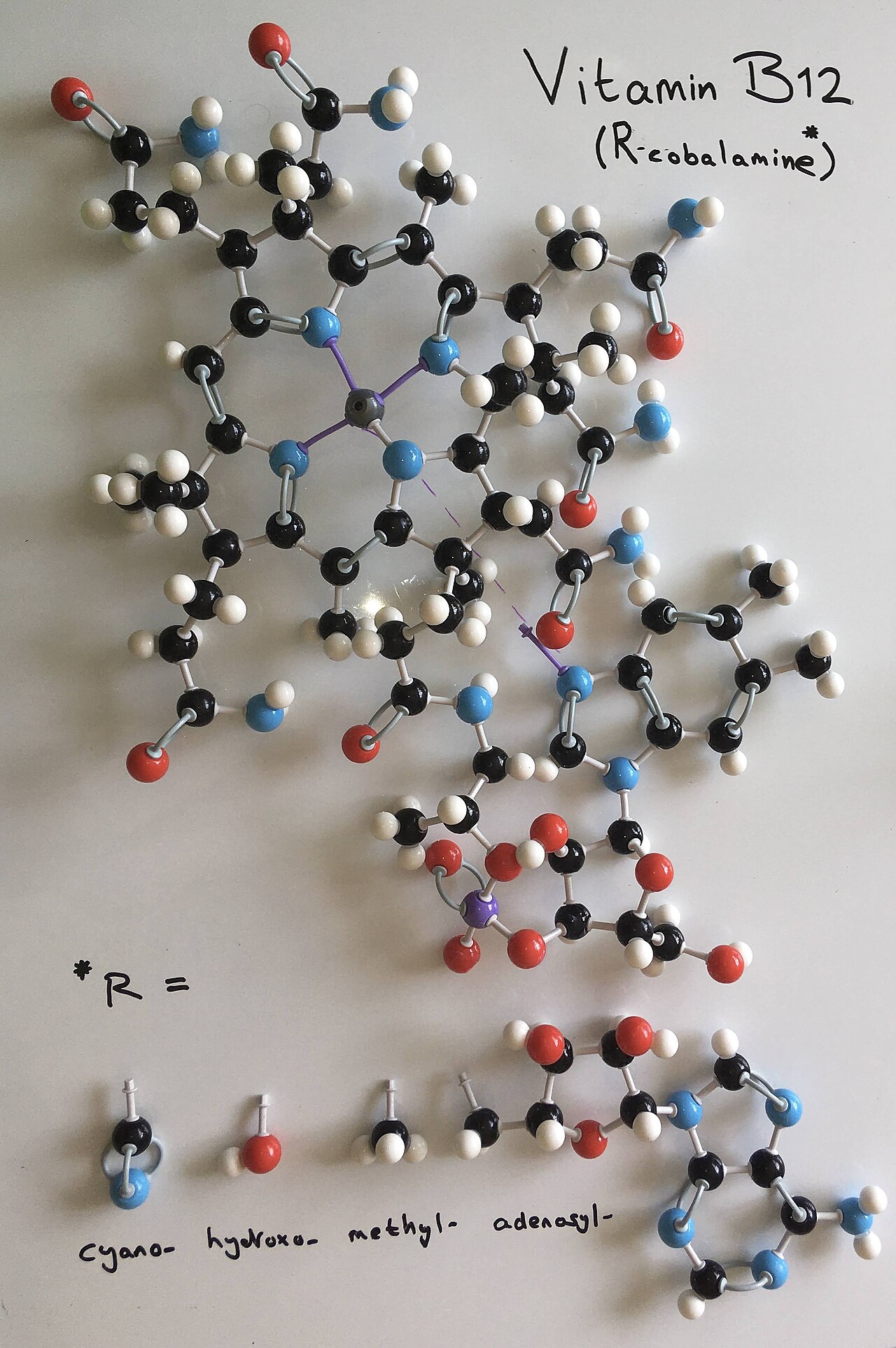
Vitamin B12 is not a single chemical form. The term covers a family of cobalt-containing compounds known as cobalamins. Methylcobalamin and adenosylcobalamin are metabolically active forms, while cyanocobalamin and hydroxycobalamin can be converted by the body into active forms.
The NIH Office of Dietary Supplements notes that cyanocobalamin remains the most common form used in dietary supplements, although methylcobalamin, adenosylcobalamin and hydroxycobalamin are also available.
The question consumers usually want answered is simpler: does choosing methylcobalamin instead of cyanocobalamin meaningfully improve absorption or effectiveness?
Short answer
Vitamin B12: key facts
| Question | Evidence-supported answer |
|---|---|
| Is methylcobalamin absorbed better than cyanocobalamin? | NIH reports no evidence that supplemental B12 absorption rates differ by form. |
| What is the adult B12 RDA? | 2.4 mcg per day for most adults. |
| How much of a 500 mcg dose is absorbed? | NIH estimates approximately 2%. |
| How much of a 1,000 mcg dose is absorbed? | NIH estimates approximately 1.3%. |
| Is sublingual B12 more effective than oral B12? | Available evidence summarized by NIH has not demonstrated a difference in efficacy. |
Is methylcobalamin absorbed better than cyanocobalamin?
Methylcobalamin has a marketing advantage because it is already one of the metabolically active forms of vitamin B12. Cyanocobalamin needs to be converted after absorption.
It is easy to turn that biochemical difference into a product claim: if one form is already active, surely the body must use it better.
Current evidence does not make that leap so neatly.
NIH states that there is no evidence showing that vitamin B12 absorption rates from supplements vary according to the form of the vitamin.
That is a surprisingly important point given how prominently supplement labels often feature the distinction between methylcobalamin and cyanocobalamin.
A review of cobalamin metabolism also concluded that methylcobalamin and adenosylcobalamin should not simply be assumed to be superior to cyanocobalamin or hydroxocobalamin for preventing or treating vitamin B12 deficiency.
That does not mean every form is identical in every biological respect. It means the label name alone is a poor basis for ranking supplements.
How much vitamin B12 is absorbed from a high-dose supplement?
The stranger part of vitamin B12 supplementation is what happens when the dose increases.
Adults require 2.4 micrograms of vitamin B12 per day under the U.S. Recommended Dietary Allowance. Yet dedicated B12 supplements commonly contain hundreds of micrograms, and products containing 500 or 1,000 micrograms are routine.
Those numbers look enormous relative to the daily requirement, but B12 absorption is not proportional to the amount swallowed.
At smaller amounts, absorption relies heavily on intrinsic factor, a protein involved in transporting B12 through the digestive system. Once that absorption pathway reaches its capacity, the percentage of a large supplemental dose that gets absorbed drops sharply.
NIH estimates absorption at roughly 2% from a 500-microgram dose and around 1.3% from a 1,000-microgram dose.
That is why comparing two products solely by asking which one contains more B12 can be misleading.
A 1,000-microgram tablet is not delivering 400 times the absorbed B12 of a 2.5-microgram dose simply because the number printed on the label is 400 times larger.
Recent controlled research using labelled cyanocobalamin also reinforces the broader point that vitamin B12 bioavailability is strongly dose-dependent.
For more context on the underlying nutrient, see Bextera’s Vitamin B12 ingredient dossier.
Is sublingual vitamin B12 better absorbed than a tablet?
B12 products also come as conventional tablets, dissolving tablets and sublingual lozenges.
Sublingual products are frequently positioned as though bypassing ordinary swallowing automatically creates a meaningful absorption advantage.
Again, the available evidence is less dramatic. NIH reports that studies have not demonstrated a difference in efficacy between oral and sublingual B12 preparations.
That makes delivery format a reasonable preference question—some people simply prefer a dissolving tablet—but not necessarily evidence of a superior supplement.
The broader lesson applies to much of the supplement aisle: product features can be real without being clinically decisive.
It is one reason consumers should read the full Supplement Facts panel rather than rely on one highlighted formulation claim. Bextera’s guide to reading Supplement Facts explains the other numbers worth checking.
Does the reason for low vitamin B12 matter more than the supplement form?
Form comparisons become even less useful when they distract from the reason B12 status may be low in the first place.
Vitamin B12 deficiency can occur because of inadequate intake, but it can also result from pernicious anemia, gastrointestinal disorders, gastrointestinal surgery or medications that interfere with B12 status.
Older adults and people following vegetarian or vegan diets are among the groups with increased risk of inadequate B12 status.
In those situations, choosing between two over-the-counter labels may not address the underlying issue.
Severe deficiency and malabsorption can require clinical evaluation and, in some circumstances, prescription treatment. NIH notes that injectable B12 is commonly used when absorption is significantly impaired, although high-dose oral therapy can also be effective in some situations.
That is a much more consequential distinction than whether the word methylcobalamin sounds more sophisticated than cyanocobalamin.
What should you compare on a vitamin B12 supplement?
For an ordinary B12 supplement, the useful comparison starts with the amount per serving, serving frequency, form, delivery method, other ingredients, cost and evidence of manufacturing or third-party testing.
The form belongs on that list. It simply should not dominate it.
Methylcobalamin is a legitimate form of vitamin B12. Cyanocobalamin is too. The fact that the body handles them somewhat differently biochemically does not establish a general rule that one produces superior absorption or better outcomes for everyone.
The most defensible reading of the current evidence is therefore less exciting than the front of the bottle: methylcobalamin versus cyanocobalamin is a real chemical distinction, but it is not, by itself, a reliable measure of supplement quality.
For Bextera, that is exactly why the label needs to be read as a specification rather than a ranking.
Bottom line
Methylcobalamin and cyanocobalamin are genuinely different forms of vitamin B12, but current evidence does not establish methylcobalamin as the generally better-absorbed option. When comparing B12 supplements, the amount per serving, reason for supplementation, absorption conditions, delivery format and overall product quality can be more useful than treating the form name as a quality ranking.
Related vitamin B12 evidence
See the vitamin B12 ingredient dossier for the broader evidence, forms, label specifications and safety context.
Sources
References used in this article
-
Vitamin B12 — Health Professional Fact Sheet
NIH Office of Dietary Supplements