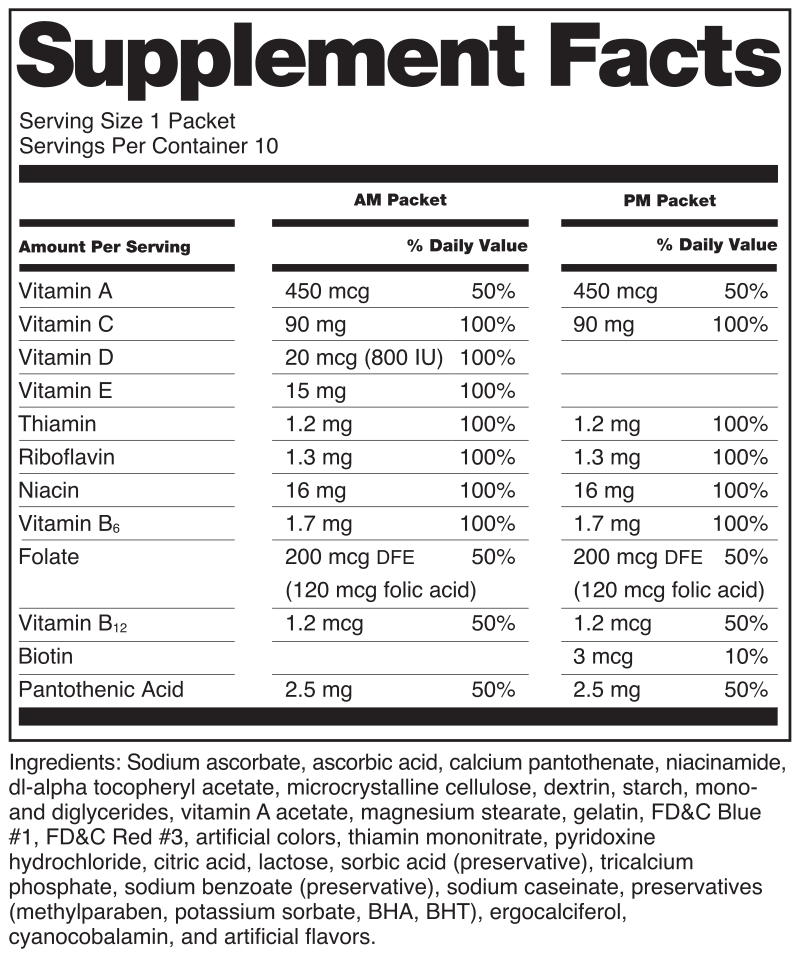
Supplement packaging is designed to be noticed.
The Supplement Facts panel is designed to tell you what the product contains.
Those are not always the same job.
A disciplined supplement comparison therefore starts on the back of the package rather than with terms such as “advanced,” “maximum,” “clinical,” or “premium.”
Short answer
Supplement Facts: what to check first
| Label field | What it tells you |
|---|---|
| Serving Size | The amount on which every listed quantity is based. |
| Amount Per Serving | The actual quantity of the dietary ingredient in one labeled serving. |
| % Daily Value | How much one serving contributes toward the FDA Daily Value where a DV exists. |
| Ingredient form | The chemical or source form can affect how a nutrient or ingredient should be interpreted. |
| Proprietary Blend | The total blend weight must be declared, but individual amounts of ingredients in the blend generally are not. |
| Other Ingredients | Excipients, flavors, colors, capsule materials and other non-dietary ingredients can appear here. |
Start with serving size
FDA requires dietary-supplement labels to identify the serving size and the quantities of dietary ingredients in that serving.
This creates the first common comparison trap.
One product might deliver its headline amount in one capsule.
Another might require three or four capsules.
Looking only at the amount without looking at the serving can make products seem more similar than they really are.
Find the actual active amount
For vitamins and minerals, identify the amount of the nutrient itself.
For example, a magnesium supplement should be compared using the declared amount of magnesium, not the visual size of the compound name or tablet.
For omega-3 products, total fish-oil weight should not automatically be treated as the EPA+DHA amount.
For protein powder, scoop weight is not the same as grams of protein.
The useful number depends on the ingredient.
Understand % Daily Value
When FDA has established a Daily Value for a dietary ingredient, the Supplement Facts panel generally provides a percentage showing how much a serving contributes.
FDA’s general guide describes:
- 5% DV or less as low;
- 20% DV or more as high.
That can be useful context.
It does not mean 100% DV is always the ideal supplement dose or that a product with 200% DV is twice as beneficial as one with 100%.
Daily Values are labeling reference points, not individualized medical prescriptions.
‘Daily Value Not Established’ is not a warning
Some supplement ingredients do not have an established Daily Value.
Their labels can state the quantity per serving while noting that Daily Value has not been established.
That statement does not itself tell you whether the ingredient is effective, ineffective, safe or unsafe.
It tells you that FDA has not established a Daily Value for that ingredient.
Those are different questions.
Proprietary blends require more attention
A proprietary blend can identify the total weight of the blend while listing multiple ingredients within it.
That can make it harder to determine the amount of each individual component.
For an evidence-based comparison, that matters.
If a study used a specific amount of an ingredient but a product does not disclose how much of that ingredient is present, it becomes difficult to determine how closely the commercial formulation resembles the research.
Front-label claims require separate verification
A package may say:
- third-party tested;
- clinically studied;
- pharmaceutical grade;
- highly bioavailable;
- doctor formulated.
Those statements should not automatically be treated as equivalent evidence.
A useful verification process asks:
Tested by whom?
Was the finished product tested or merely an ingredient?
Is there an accessible certification record?
Does the cited study test this actual formulation?
That changes a vague claim into something that can be checked.
Compare products using normalized units
Once you understand the label, normalize the information.
Depending on the product, useful calculations can include:
- cost per gram of creatine;
- cost per 100 mg elemental magnesium;
- cost per 25 g protein;
- EPA+DHA per serving;
- vitamin D in both mcg and IU.
Normalization prevents package size and serving conventions from distorting the comparison.
The front is for positioning; the panel is for specification
That does not mean front-of-pack information is useless.
Flavor, dietary restrictions, intended use and convenience matter.
But those fields should be evaluated after the specification is understood.
The simplest rule is:
Read the serving. Read the amount. Identify the form. Then evaluate the claim.
That sequence removes a surprising amount of noise from supplement shopping.
Sources
References used in this article
-
Dietary Supplement Labeling Guide: Nutrition Labeling
U.S. Food and Drug Administration
-
Daily Value on the Nutrition and Supplement Facts Labels
U.S. Food and Drug Administration
Hero image: U.S. Food and Drug Administration · Public domain