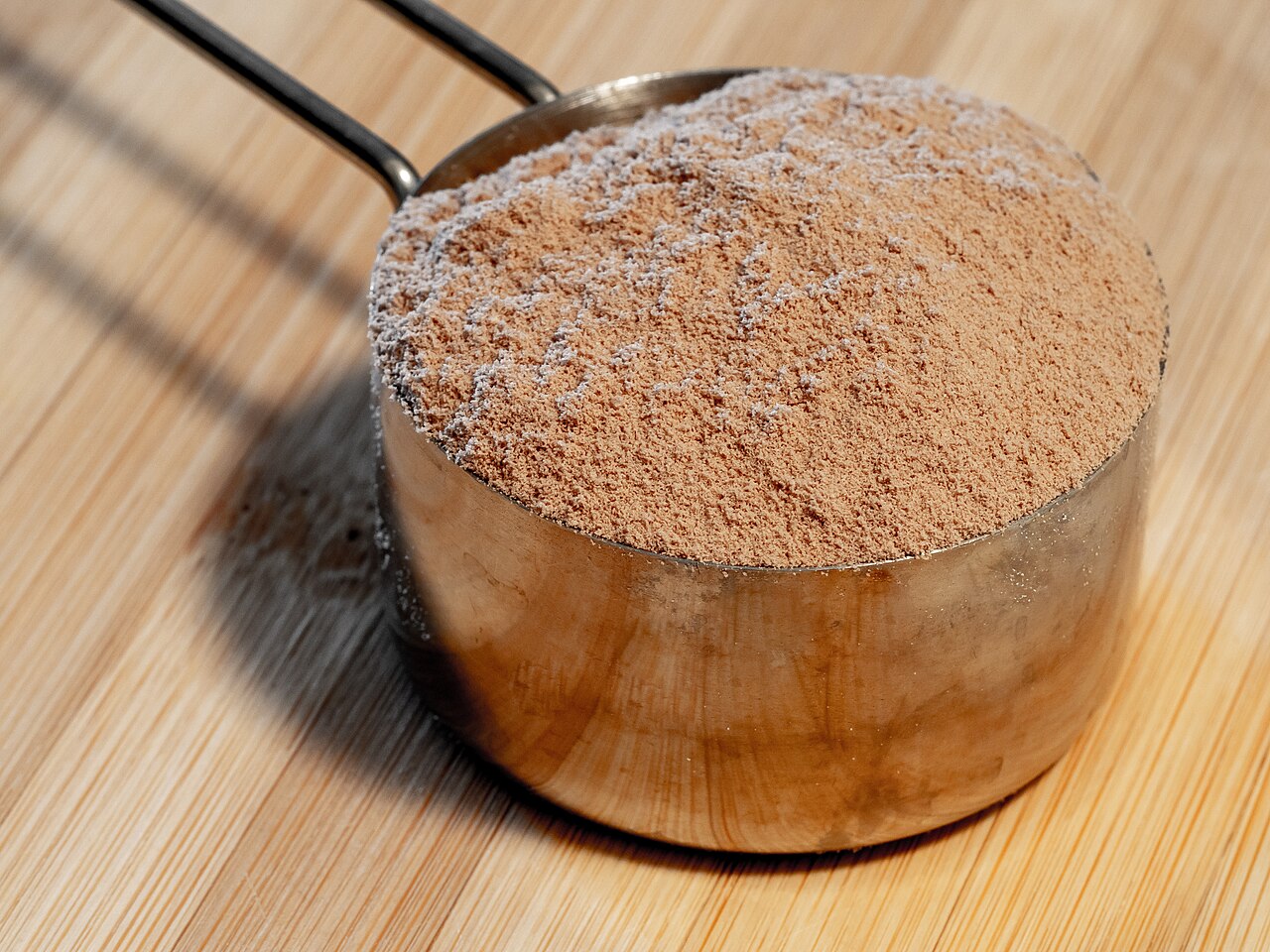
Whey protein isolate usually costs more than whey protein concentrate.
That price difference encourages a simple conclusion:
isolate must be the better protein.
The label differences are real.
But “more processed” and “higher protein percentage” do not automatically mean “builds more muscle.”
The useful comparison starts with what the processing actually changes.
Short answer
Both products begin with whey
Whey is one of the major protein fractions in milk.
During processing, whey can be filtered and concentrated to produce powders with different proportions of:
- protein;
- lactose;
- fat;
- minerals;
- moisture;
- other milk-derived components.
The distinction between concentrate and isolate is therefore mainly a composition and processing distinction.
It is not a change from low-quality protein to high-quality protein.
Both remain whey proteins containing the essential amino acids.
What changes with whey isolate?
Additional processing removes more non-protein material.
As a result, isolate typically provides:
- a higher percentage of protein by weight;
- less lactose;
- less fat;
- fewer calories from non-protein components per equivalent amount of protein.
That can be useful.
Someone trying to maximize protein while limiting lactose or other macronutrients may prefer an isolate.
But those advantages are product-specification advantages.
They do not automatically prove a superior training adaptation.
Whey concentrate is not one fixed composition
The word concentrate can be misleading because whey concentrates can vary.
Different products can provide substantially different proportions of protein.
That is why Bextera does not rank a product simply because the front label says “concentrate.”
A better calculation is protein yield:
how many grams of the serving are actually protein?
Bextera’s whey protein dossier uses this approach to normalize products with different scoop sizes.
A 35-gram scoop providing 24 grams of protein and a 30-gram scoop providing 25 grams should not be compared by scoop weight alone.
Is isolate absorbed better?
Both whey concentrate and isolate are highly digestible protein sources.
The difference in processing does not justify describing concentrate as a poorly absorbed protein.
Isolate may be more suitable for some people because it normally contains less lactose and non-protein material.
That is different from saying every gram of isolate produces a meaningfully greater muscle-building response than every gram of concentrate.
Those are separate claims.
What does the research show about body composition?
A 2019 systematic review and meta-analysis examined whey protein concentrate, isolate and hydrolysate across randomized trials in physically active people.
The study included eight randomized trials and 246 participants.
Importantly, the analysis did not provide a clean direct head-to-head trial showing isolate beats concentrate.
The forms were largely evaluated in subgroups against isocaloric control conditions.
The researchers did not find a statistically significant fat-free-mass effect across the analyzed scenarios and explicitly noted important limitations in the evidence.
That means the study should not be turned into:
“Concentrate is better.”
or:
“Isolate is better.”
It mainly demonstrates how much weaker the form-versus-form outcome evidence is than supplement marketing often implies.
What about newer whey research?
A 2026 systematic review and meta-analysis of whey and soy supplementation in young adults found selected strength improvements associated with whey but did not find a significant lean-body-mass effect from whey supplementation across the included studies.
Again, that does not answer isolate versus concentrate directly.
It reinforces a larger point:
the training outcome depends on more than the word printed after “whey” on the ingredient list.
Total protein intake, resistance training, energy intake and adherence all matter.
When isolate genuinely makes sense
There are several practical reasons someone may choose isolate.
Higher protein density
A larger proportion of the powder is typically protein.
Lower lactose
People who tolerate some dairy but are sensitive to larger lactose amounts may find some isolates easier to use.
This is not the same as milk-protein allergy. Whey isolate is still milk-derived protein.
Lower fat or carbohydrate
If those differences matter to a person’s overall diet, isolate can make label comparison easier.
Smaller amount of powder for similar protein
Higher protein yield can sometimes mean less total powder is needed for the same protein target.
Those are legitimate reasons.
None require claiming that isolate is intrinsically more anabolic.
Why concentrate may still be the better buy
Concentrate is often less expensive.
If a concentrate provides a useful amount of protein, is well tolerated and fits someone’s dietary needs, paying significantly more for isolate may offer little practical advantage.
That is why Bextera compares cost per normalized protein amount, not simply price per tub.
A cheap container can be poor value if each serving contains little protein.
An expensive isolate can also be poor value if its compositional advantages are irrelevant to the buyer.
Do the extra components in concentrate make it healthier?
This claim also needs restraint.
Whey concentrate can retain more non-protein milk components than highly filtered isolate.
That fact alone does not establish a clinically meaningful health advantage.
A different composition is not automatically a better composition.
The relevant question is what outcome the consumer is trying to achieve.
Is hydrolyzed whey another step above isolate?
Hydrolyzed whey has undergone additional processing that breaks some protein chains into smaller peptides.
It is often marketed as faster or more advanced.
But once again, processing category should not function as a universal ranking system.
The finished product still needs to be evaluated by protein amount, tolerability, price and the evidence for the outcome being claimed.
What should you compare on the label?
For most whey powders, start with:
- protein grams per serving;
- total serving weight;
- protein yield;
- concentrate, isolate or hydrolysate form;
- lactose and carbohydrate context if relevant;
- calories;
- cost per normalized amount of protein;
- additional ingredients.
That produces a far more useful comparison than:
isolate = premium, concentrate = basic.
Bextera’s article on whether whey is better than other protein powders explains the broader protein-source evidence.
The takeaway
Whey isolate and concentrate are genuinely different products.
Isolate is usually more protein-dense and contains less lactose, fat and other non-protein material.
Those differences can make it the better choice for a particular person.
But the evidence does not establish that the word isolate automatically delivers better muscle growth than an adequate amount of whey concentrate.
For most comparisons, the better questions are:
How much protein does the serving actually provide, what else is in it, is it tolerated, and what does that protein cost?
Sources
References used in this article
-
Dietary Supplements for Exercise and Athletic Performance — Protein
NIH Office of Dietary Supplements
-
Comparative Meta-Analysis of the Effect of Concentrated, Hydrolyzed, and Isolated Whey Protein Supplementation on Body Composition of Physical Activity Practitioners
Nutrients · PMID 31480653
-
The Impact of Whey and Soy Protein Supplementation on Resistance Training in Young Adults
Journal of Dietary Supplements · PMID 41454445
Hero image: Ajay Suresh / Wikimedia Commons · CC BY 2.0