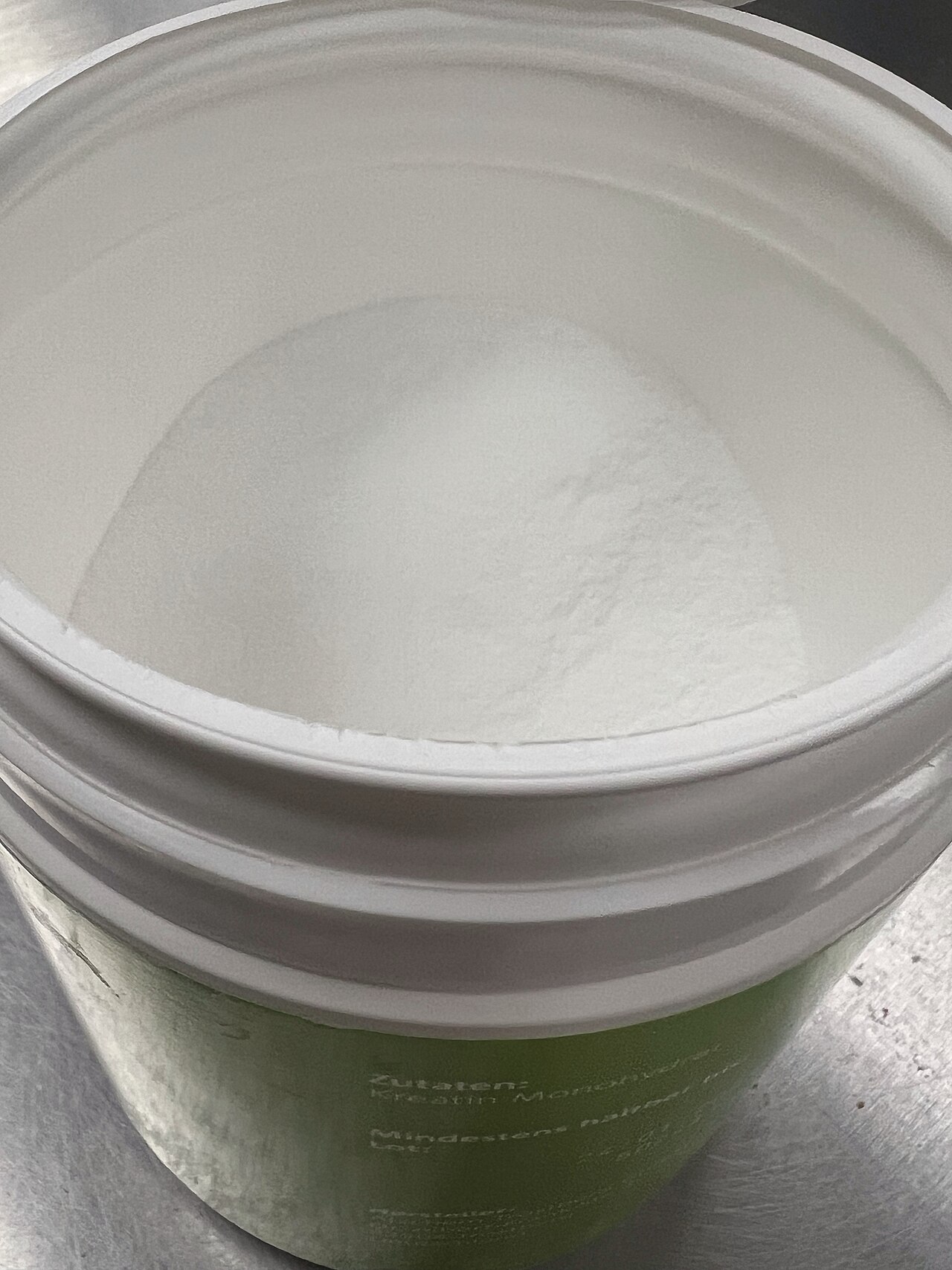
Creatine hydrochloride has an appealing marketing argument.
It dissolves much more readily in water than creatine monohydrate.
The harder question is whether that physicochemical advantage actually produces better results in humans.
At the moment, the evidence does not show that it does.
Bextera evidence comparison
Creatine HCl is substantially more soluble in water, but greater solubility has not been shown to produce superior training, strength or body-composition outcomes. Creatine monohydrate retains the much broader evidence base.
| Specification | Creatine Monohydrate | Creatine HCl | Evidence |
|---|---|---|---|
| Form | Creatine monohydrate | Creatine hydrochloride salt | Source |
| Aqueous solubility | Lower reference solubility | About 38× higher in one physicochemical study | Source |
| Caco-2 permeability | Reference | No significant permeability advantage demonstrated | Source |
| Direct human comparison | Tested with and without a loading phase in a 2024 resistance-training RCT | Tested at 0.03 g/kg/day in the same 2024 RCT | Source |
| Head-to-head outcome | Improved measured training outcomes versus placebo | Improved measured training outcomes but showed no benefit over monohydrate | Source |
| Breadth of evidence | Extensive evidence for bioavailability, efficacy and safety | Much more limited human efficacy evidence | Source |
What this comparison cannot establish
- The direct 2024 trial included only 40 participants divided across four groups, leaving approximately 10 participants per group.
- The trial lasted eight weeks and involved young adults performing resistance training.
- Greater aqueous solubility is a physicochemical property and should not automatically be interpreted as greater clinical effectiveness.
- A finding of no superiority in one relatively small trial does not prove that the two forms are identical in every population or outcome.
- Physicochemical Characterization of Creatine N-Methylguanidinium Salts Physicochemical / permeability study · 2012
- Creatine Hydrochloride vs Creatine Monohydrate Alongside Resistance Training Randomized controlled trial · 2024
- Bioavailability, Efficacy, Safety, and Regulatory Status of Creatine and Related Compounds: A Critical Review Critical review · 2022
- Efficacy of Alternative Forms of Creatine Supplementation on Improving Performance and Body Composition Systematic review · 2022
The difference starts with chemistry
Creatine monohydrate consists of creatine associated with a molecule of water.
Creatine hydrochloride is a creatine salt formed with hydrochloric acid.
Changing the form changes physical properties such as aqueous solubility.
That is real.
The mistake is jumping directly from:
more soluble
to:
more effective.
Those are different claims requiring different evidence.
HCl is substantially more soluble
A laboratory characterization of several creatine salts reported that creatine hydrochloride was approximately 38 times more soluble in water than creatine monohydrate.
That is a meaningful formulation property.
A powder that dissolves more readily may allow manufacturers to formulate smaller servings or more concentrated liquids.
But the same study also examined permeability using Caco-2 cell monolayers.
Creatine HCl did not demonstrate a significant permeability advantage over creatine monohydrate in that model.
So even within the laboratory evidence, greater solubility should not automatically be translated into greater absorption.
Human outcomes matter more than the glass of water
For a sports supplement, the clinically useful questions are ultimately things such as:
- Does the form increase strength more?
- Does it increase muscle creatine more?
- Does it improve body composition more?
- Can it achieve comparable effects with meaningfully less creatine?
- Does it produce fewer adverse effects?
Those require human comparative studies.
For creatine HCl, that evidence base remains much smaller than the evidence base for monohydrate.
The 2024 head-to-head trial
A 2024 randomized study compared resistance training combined with creatine HCl, creatine monohydrate with loading, creatine monohydrate without loading, or placebo.
Forty participants aged 18–25 were divided among four groups.
The HCl group consumed 0.03 g/kg/day.
One monohydrate group used a five-day loading phase of 0.3 g/kg/day followed by 0.03 g/kg/day, while another monohydrate group used 0.03 g/kg/day without loading.
Participants resistance trained for eight weeks.
Both forms worked — HCl did not outperform monohydrate
The creatine groups improved several measured outcomes compared with placebo, including strength and body-composition measures.
But the important comparison for this page is not creatine versus placebo.
It is HCl versus monohydrate.
The study authors concluded that creatine HCl showed no benefit over creatine monohydrate.
That directly challenges the idea that greater solubility has already been shown to produce superior training results.
One trial is not the same as a mature evidence base
The study is useful because direct HCl-versus-monohydrate trials are uncommon.
It is not definitive proof that every outcome will always be identical.
With 40 participants split into four groups, each group was small.
The intervention lasted eight weeks and involved young adults undergoing resistance training.
So Bextera treats the result as:
no superiority demonstrated in the available direct trial
rather than:
all forms are proven equivalent under every condition.
The evidence-base imbalance is much larger than the chemistry difference
Creatine monohydrate has decades of human research behind it.
Systematic reviews and critical reviews consistently identify monohydrate as the creatine form with the strongest evidence for bioavailability, efficacy and safety.
Alternative forms have generally been studied far less extensively.
A systematic review of alternative creatine forms found relatively few direct comparisons with monohydrate and no consistent evidence that alternative forms produced greater performance benefits.
That evidence asymmetry matters when comparing products.
A new chemical form does not inherit the complete evidence base of monohydrate merely because both ultimately provide creatine.
Lower serving size needs evidence too
Creatine HCl products are sometimes marketed around the idea that substantially smaller amounts are sufficient.
Better solubility alone cannot establish that claim.
To support a lower-dose superiority claim, we would want controlled research showing that the lower amount produces equivalent or superior effects on relevant human outcomes.
The 2024 trial gives HCl useful human evidence.
It does not establish that every low-dose commercial HCl formulation is equivalent to a well-studied monohydrate protocol.
Product comparisons should therefore separate four questions
When Bextera eventually compares commercial creatine products, we will separate:
1. Chemical form
Is it monohydrate, hydrochloride, or another form?
2. Actual creatine amount
How much is supplied per serving?
3. Evidence supporting that form and amount
Has the exact form been studied in meaningful human trials?
4. Commercial specification
What does the usable amount cost, and are purity or testing claims independently verifiable?
That prevents one favorable physical property from becoming a proxy for overall product quality.
Bottom line
Creatine HCl has a genuine formulation advantage in water solubility.
What has not been demonstrated is a corresponding advantage in training outcomes over creatine monohydrate.
The available direct human trial found no benefit of HCl over monohydrate, while the overall human efficacy and safety literature remains substantially deeper for monohydrate.
For Bextera, that makes the evidence position straightforward:
better solubility is a product property. Superior clinical performance is a separate claim — and it still requires evidence.
Hero image: Awkwafaba · CC BY-SA 4.0